முகரம்(அரபி: محرم)என்பது இஸ்லாமிய ஆண்டின் முதலாவது மாதமாகும்.இசுலாமிய ஆண்டின் நான்கு புனித மாதங்களில் இதுவும் ஒன்று.இசுலாமிய நாட்காட்டி ஓர் சந்திர நாட்காட்டியானதால் கிரெகொரியின் நாட்காட்டியுடன் ஒப்பிடும்போது இது ஆண்டிற்காண்டு நகருவது போன்று காட்சியளிக்கும்.இந்த மாதத்தில் சண்டைகள் தடைசெய்யப்பட்டுள்ளது.சில இசுலாமியர் இம்மாதத்தின்போது உண்ணாநோன்பு இருத்தல் வழமையாகும்.முகரம் மாதத்தின் பத்தாம் நாள் (அராபிய மொழியில்அஷுரா)அன்று தியாகத்திருநாளாகக் கொண்டாடப்பட்டு அன்று சியா இசுலாமியர் உண்ணாதிருப்பர். சன்னி இசுலாமியரும் ஒன்பதாம் அல்லது பதினொராம் நாளில் உண்ணாதிருப்பர்.
முகரம் பண்டிகை (Remembrance of Muharram) கர்பாலா போரில் முகம்மது நபி(ஸல்) அவர்களின் பேரனான உசேன் பின் அலி மாவீரரானதை நினைவுகூருகிறது.

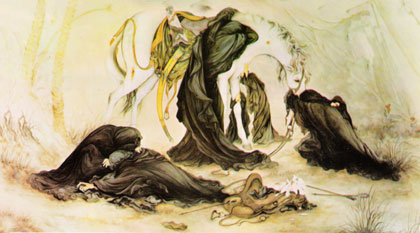
Ashura - Martyrdom of Imam Husayn
(10th Muharram - Ashura)"When nobody except a group of three members of his family was left with al-Husayn, he moved against the people (the soldiers), while the three (moved with) him until (all) three were killed. Al-Husayn was left alone. Despite being weighed down by wounds in his head and body, he began to strike against them (the enemy) with his sword and they scattered, to right and left, away from him.
Humayd b. Muslim said: "By God, I have never seen such persistence. His sons have been killed, and the members of his household and his followers, yet he is still as brave as ever and he has not allowed his spirit to leave him...."
When Shamir b. Dhi al-Jawshan realised (the position), he called for the cavalry and they came up at the rear of the foot-soldiers. He ordered the archers to shoot at (al-Husayn) and they showered him with arrows until his (armour) became (quilted with arrows)....
Then Shamir b. Dhi al-Jawshan shouted at the foot soldiers and the calvary: "Why are you waiting for the man? May your mothers be deprived of you!" So they attacked him from every side.
Zur'a b. Sharik struck him on the left shoulder-blade and cut into it. Another of them struck him on the shoulder. He fell prostrate on his face. Sinan b. Anas al-Nakha'i stabbed him with a spear and killed him. Khawali b. Yazid al-Asbahi) hurried to him and bent down to cut off his head but he trembled (too much). Shamir said to him: "May God crush your arm why are you trembling?" Then Shamir bent down and decapitated him. He lifted the head (and handed it) to Khawali saying: "Take it to the commander 'Umar b. Sa'd."
Then they began to plunder (the body of) al-Husayn. Ishaq b. al-Hayat al-Hadrami, may God curse him, took his shirt. Abjar b. Ka'b, may God curse him, took his trousers. Akhnas b. Marthad, may God curse him, took his turban. One of the Banu Darim took his sword. They plundered his saddle and his camel and they looted his womenfolk.
Humayd b. Muslim reported: By God, I did not see one of his women or daughters or the women of his family who did not have her clothes ripped from her back, taken away and removed from her forcibly. Then we came to 'Ali b. al-Husayn. He was stretched out on a bed and he was very ill. Shamir had a group of foot-soldiers with him and they asked him, "Shall we kill this sick one?" I said: "Praise be to God, will boys be killed (too)? This is only a youth even though he is what he is." And I went on (arguing) until I had moved them away from him.
Then Umar b. Sa'd arrived and.the women cried out and wept in his face. He ordered his followers: "None of you should enter the tents of these women nor disturb this sick boy." The women asked him to return what had been taken from them so that they could clothe themselves again. So he commanded that whoever had taken any of their belongings should return them to them. But by God, none of them returned anything. He then entrusted charge of the main tent and the tents of the women to a group (of men) who were with him. He said: "Guard (the women) so that none of them may leave and do not harm them."
"Who will volunteer (to go) to al-Husayn and make his horse trample on (al-Husayn's body)?" Ten volunteered. Of these, Ishaq b. Hayyat and Akhnas b. Marthad trampled on (the body of) al-Husayn with their horses until they had broken, and bruised his back.
Umar b. Sa'd despatched on that day - it was, the day of Ashura, - the head of al-Husayn, with Khawali b. Yazid al-Asbahi and Humayd b. Muslim al-Azdi, to Ubayd Allah b. Ziyad. Then he ordered the heads of the remainder of his followers and members of his House (who had been slain) to be cut off. There were seventy-two heads. He sent Shamir b. Dhi al-Jawshan, Qays b. Ash'ath and Amr b. al-Hajjaj with these. They journeyed until they brought them to Ibn Ziyad. He took with him the daughters and sisters of al-Husayn, together with Ali b. al Husayn. The latter was sick with a dysentry and was almost on the point of death.
When Ibn Sa'd departed, some of Banu Asad, who had been staying at al-Ghadiriyya went to al-Husayn, and his followers. They performed the funeral prayer over them. Then they buried al-Husayn at the place where his tomb still is, and they buried his son Ali b. al-Husayn al-Asghar (the younger) at the foot of the body. They dug around the area next to the two feet of al-Husayn, for the martyrs from his House and his followers. They gathered them together and buried them all together. However, they buried al-Abbas b. Ali, in the place where he was killed, on the road to al-Ghadiriyya, where his tomb still is.
After Ibn Ziyad had despatched the head of al-Husayn to Yazid, he went to Abd al-Malik b. Abi al-Harith al-Sulami and told him, "Go to Amr b. Sa'id b. al-As in Medina and give him the good news of the killing of al-Husayn"
Abd al-Malik reported:
When I went to Amr b. Sa'id, he asked: "What is your purpose?"
"What will please the governor," I answered, "Al-Husayn has been killed."
"Go out and announce his being killed," he told me.
I announced (it). I have never heard such wailing as the wailing of
the Banu Hashim in their houses for al-Husayn b. Ali, when they heard the announcement of his death. I went back (in) to Amr b. Sa'id. When he saw me, he smiled at me and laughed. Then he quoted a verse of Amr b. Ma'dikarib:
'Then women of Banu Ziyad raised a great lament like the lamentation of our women mourning (after the battle) of al -Arnab.'
....Umm Luqman, the daughter of Aqil b. Abu Talib, came out crying when she heard the news of the death of al-Husayn. With her were her sisters Umm Hani, Ramla and Zaynab, daughters of Aqil b. Abu Talib, may God have mercy on them. She wept for her (relatives) slain on the bank and she recited:
"What would you say if the Prophet asked you: What have you, the last of the (religious) communities, done
With my offspring and my family after my departure from them? They are prisoners and slain and have been stained with their own blood.
What sort of reward is this for my advice to you - that you should now oppose me by doing evil to my household (to my near ones)."
"Say (to the people, O Prophet): I do not ask of you any reward...but love for my near relatives; and whoever earns good, We give him more of good therein; surely Allah is Forgiving, Grateful." (Qur'an 42:23)
New Year's Day - Mourning the Imam
On the occasion of the first of Muharram (the Muslim New Year and the beginning of 10 days of mourning for the grandson of the Prophet (s.a.), slain at Kerbala)
A new year signifies renewal, birth, new beginnings. While the 1st of Muharram marks the new year celebration for many Muslims - for others it marks a time of mourning and contemplation. But this is not an inappropriate activity for a new beginning.
It is a time of looking back at what has passed with the intention of setting right that which has gone astray within ourselves and our society. This is a serious task and a weighty duty, but one which, if approached with the correct intention and attitude, is a deeply satisfying and rewarding activity.
A new year is a new beginning and a beginning is a time for taking great care that one's aims are correct, one's intentions are pure, and that one's energies are correctly directed and not wastefully spent.
What better forum is there than the majlis held to commemorate the martyrdom of Imam Husayn (a.s.) for such an activity. Here, we gather as a community for a common cause, all of us in a state of mind receptive to the lessons to be learned from from this incident that we come here to commemorate - an incident that serves all the purposes that a new year is truly meant to serve - to renew us - to provide fresh purpose and a new beginnning.
Kerbala is a microcosm. In the events of 10 days, in that one spot on earth, all the great lessons of the Qur'an were brought to life in front of the witness of history - and all those who were (or are today) in doubt that the highest ideals of the Qur'an could be lived up to - all those who felt that the highest Qur'anic ideals were beyond the reach of humans - were in that place on Earth, that Kerbala, proved wrong. Doubts were shattered, and the jewels of Qur'anic truth were brought out and displayed in the desert of Kerbala, shining with such a light that even today, so many centuries later, our vision is dazzled by those human gems.
Kerbala is the Qur'an in action - at Kerbala is to be found a most profound tafsir of the Qur'anic ayats (verses).
And Kerbala came at a time when the islam of the Muslim state had deviated dramatically from the Islam of the Prophet (s.a.). It came at a time when the very foundations of the religion were under attack, when the government of that time had become so emboldened, so full of spite for the truth, so drunk with their worldly power and so blind to their own faults and limitations, that they aimed their spears at the hearts of the dearest members of the Prophet's family. The Prophet was gone so they would vent their hatred at his family and at any who stood with them - this while they claimed the Prophet's Islamic heritage for themselves and declared the Prophet's closest family members and companions to be disobedient rebels.
This was a time of great despair for believers. The beauty, justice, and mercy of Islam had been cast aside, the dazzling societal structures created by the first generation of Muslims seemed to be in ruins - the Prophet's former enemies, the Umayyads were kings over the Muslim empire - their self-declared caliphate a mockery of what that office was meant to be and of what it had once been. They were at the summit of their power so they did what they willed, while the Prophet's family were made strangers in their grandfather's own home, disinherited and removed from all worldly power while their spiritual authority was falsely challenged and called into question.
But the Qur'an says: "And we wished to show favour unto those who were oppressed in the land, and to make them Imams, and to make them the inheritors." (Qur'an 28:5)
And at the beginning of the Muslim New Year in the year 61 AH, the greatest act of renewal was begun. The events of the first 10 days of Muharram marked the point of a new beginning for Islam - when what was deviated was set right - when what was wrong was exposed in such a way that the shame of the wrongdoers has been manifested to every succeeding generation - and a weakened Islam was revived, restored, and reconnected with its spiritual and intellectual roots.
"Good is not that your possessions, wealth (and power)...increase, but good is that your knowledge increases and your insight grows more powerful, and that the people are proud to serve God. For when you do good, you praise God...." (Imam Ali)
For us too, this New Year, this Muharram, should be a time of renewal, for setting right what has deviated in us, for strengthening the bonds of community, for looking closely at the deep and profound spiritual and intellectual roots of Islam - and a new beginning with a pure intention for the year to come.

.jpg)